|
|
|
|
|
|
 |
 |
|
|
|
|
|
|
|
|
|
|
|
|
|
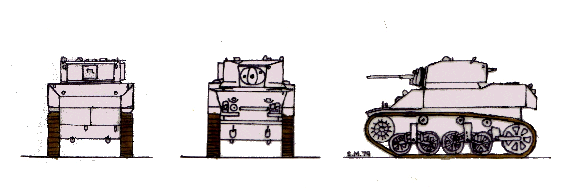
The Light Tank M5A1 was a Light Tank designed in 1941, it was based on the fully tracked Light Tank chassis and was in use from 1942 to 1990. It was commonly called a Stuart. |
|
| General Details (Light Tank) |
|---|
| | Specifications | | Operational Date(s) | 1942 - 1990 | | Quantity Produced | 6810 | | Weight | 15 tonne | | Crew | 4 | | M.G's small | 3 | | M.G's large(>10mm) | n/a | | Length | 4.89 mtr | | Width | 2.31 mtr | | Height | 2.43 mtr | | Engine Details/Performance | | Max Road Speed | 40 mph | | Max Cross Country Speed | 24 mph | | Range Road | 100 miles | | Range Cross Country | 40 miles | | Fuel Type | Petrol | | Fuel Capacity | 89 gal | | Horse Power | 220 hp | | Power/Weight | 14 hp/tonne | | | General Information | The Light Tank M5A1 was a Light Tank designed in 1941, it was based on the fully tracked Light Tank chassis and was in use from 1942 to 1990. It was commonly called a Stuart.
The vehicle was powered by Cadillac 'Series 42' petrol powerplant producing 220 HP which could drive the vehicle on roads at up to 40 mph with a range of about 100 miles before refuelling. Its cross country performance was good providing a max speed of about 24 mph and a range of about 40 miles.
It was armed with 3 light machine guns which were 0.3 inch Browning Machine Gun M1919A4s. Its main armament consisted of a 37mm Antitank Gun M6 firing a shell weighing 0.7 kg to a maximum range of 3,000 metres.
The Light tank M5A1 was a tank based on the M5 with the 37mm anti tank gun having a gyrostabiliser.
The power was provided by twin Cadillac 121hp petrol engines, driving through the front drive wheel, then via 2 pairs of road wheels to a rear idler then back over 3 return rollers.
This model was all welded and had a bulge at the rear of the turret for a radio. | |
| | Turret | | Front | | 51mm | @ | 0° | (51mm) | | Side | | 32mm | @ | 0° | (32mm) | | Rear | | 32mm | @ | 0° | (32mm) | | Top | | 12mm | @ | 90° | (12mm) |
| | Superstructure | | Front | | 57mm | @ | 45° | (81mm) | | Side | | 28mm | @ | 0° | (28mm) | | Rear | | 28mm | @ | 0° | (28mm) | | Top | | 9mm | @ | 90° | (9mm) |
| | Hull | | Front | | 57mm | @ | 45° | (81mm) | | Side | | 28mm | @ | 0° | (28mm) | | Rear | | 28mm | @ | 0° | (28mm) | | Top | | 9mm | @ | 90° | (9mm) |
| | Armour (x)mm @ (y)° (Effective mm @ 0°) | | Effective Armour - Maximum 81 mm - Minimum 9 mm |
| | Weapon Details |
|---|
|
37mm Antitank Gun M6
(Anti Tank Gun) |
 |
| | History | |
|---|
| | This was the Tank mounted version of the 37mm M3 |
| | Manufacturer | Watervliet Arsenal |
|---|
| | Calibre | 37mm |
|---|
| | Number of Rounds | 147 |
|---|
| Ammunition Details |
|---|
| Name/Id |
Calibre Weight MVelocity |
Explosive Content |
|
AP M74 Shot
(AP Armor Piercing)
|
37mm 0.86Kg 885M/Sec | |
| Quoted Penetration 36mm @ 500mtr/0° |
| Range(Mtr) | 100 | 200 | 400 | 800 | 1200 | 1600 | 2000 | 2400 |
|---|
| Flight Time(Secs) |
0.12 |
0.23 |
0.49 |
1.04 |
1.65 |
2.32 |
3.05 |
3.83 |
|---|
| Penetration(mm@30°) |
60 |
57 |
51 |
42 |
34 |
27 |
22 |
18 |
|---|
| Penetration(mm@0°) |
70 |
67 |
60 |
49 |
39 |
32 |
26 |
21 |
|---|
| Hit Probability(%) |
79 |
79 |
79 |
71 |
55 |
44 |
20 |
12 |
|---|
|
HE M63 Shell
(HE High Explosive)
|
37mm 0.73Kg 792M/Sec | 0.039Kg explosive |
| Maximum Range not shown as gun elevation is limited |
| Range(Mtr) | 100 | 200 | 400 | 800 | 1200 | 1600 | 2000 | 2400 |
|---|
| Flight Time(Secs) |
0.13 |
0.26 |
0.55 |
1.17 |
1.88 |
2.65 |
3.5 |
4.4 |
|---|
| lateral dispersion means the side to side variation of the shell from the aiming point |
|---|
| 50%(CEP) of shells land within +/- (mtr) |
0.12 |
0.12 |
0.12 |
0.21 |
0.32 |
0.43 |
0.53 |
0.64 |
|---|
| 80% of shells land within +/- (mtr) |
0.15 |
0.15 |
0.15 |
0.27 |
0.41 |
0.55 |
0.68 |
0.82 |
|---|
| 95% of shells land within +/- (mtr) |
0.24 |
0.24 |
0.24 |
0.41 |
0.63 |
0.84 |
1.04 |
1.25 |
|---|
| range dispersion means the back to front variation of the shell from the aiming point |
|---|
| 50%(CEP) of shells land within +/- (mtr) |
0.15 |
0.15 |
0.15 |
0.27 |
0.40 |
0.53 |
0.67 |
0.80 |
|---|
| 80% of shells land within +/- (mtr) |
0.19 |
0.19 |
0.19 |
0.35 |
0.51 |
0.68 |
0.86 |
1.02 |
|---|
| 95% of shells land within +/- (mtr) |
0.29 |
0.29 |
0.29 |
0.53 |
0.78 |
1.04 |
1.31 |
1.57 |
|---|
| Direct Fire |
| Range(Mtr) | 100 | 200 | 400 | 800 | 1200 | 1600 | 2000 |
|---|
| Flight Time(Secs) |
0.13 |
0.27 |
0.56 |
1.23 |
1.99 |
2.84 |
3.77 |
|
|---|
| Hit Probability(%) |
79 |
79 |
76 |
71 |
55 |
30 |
12 |
|---|
| Blast/Fragmentation Effects |
| Burst radius Infantry in open 99% kill | 0 mtr |
Burst radius Infantry in open 66% kill | 1 mtr |
|---|
| Burst radius Infantry in open 33% kill | 3 mtr |
Armour Penetration inc roof at 1 mtr | 0 mm |
|---|
| An explosion within 1 mtr of infantry in the open will cause > 66% casualties and could damage some AFV's. |
| An explosion within 3 mtr of infantry in the open will cause 33% casualties. |
| The blast effect of this shell exploding within 1 mtr of an armoured vehicle will not cause any significant armour damage. |
| Weapon Details |
|---|
|
0.3 inch Browning Machine Gun M1919A4
(Machine Gun) x 3 |
|
| | Manufacturer | Browning |
|---|
| | Manufactured | 1919 - 1945 |
|---|
| | Calibre | 7.60mm |
|---|
| | Length | L/80 |
|---|
| | Rate of Fire | 480 rpm |
|---|
| | Number of Rounds | 6750 |
|---|
| Ammunition Details |
|---|
| Name/Id |
Calibre Weight MVelocity |
Explosive Content |
|
.30-06 Springfield
(BALL Standard Small Arms)
|
7.62mm 0.012Kg 820M/Sec | |
| Range(Mtr) | 100 | 200 | 400 | 800 | 1200 | 1600 | 2000 | 2400 |
|---|
| Flight Time(Secs) |
0.12 |
|
|
|
|
|
|
|
|---|
| Penetration(mm@30°) |
1 |
|
|
|
|
|
|
|
|---|
| Penetration(mm@0°) |
2 |
|
|
|
|
|
|
|
|---|
| Hit Probability(%) |
74 |
|
|
|
|
|
|
|
|---|
About Penetration Figures
All penetration figures in this database are calculated to a common standard
based on German WWII testing criteria (complete penetration with functioning fuze).
This allows direct comparison between all nations' guns.
Original national test figures would be higher for some nations due to different criteria:
- German: 1.00? (baseline - strictest)
- British: 1.02? (slightly looser)
- American: 1.05? (50% mass through plate)
- Soviet: 1.10? (75% mass through plate)
For example, a Soviet gun showing 159mm here would be published as ~175mm in Soviet documents,
and a German gun showing 120mm would be published as 120mm in German documents.
The 159mm figure is directly comparable to the German 120mm - the Soviet gun really was more powerful.
|
| National Testing Standards |
|---|
| German: | 1.00? - Complete penetration, fuze functions (strictest) |
| British: | 1.02? - Complete penetration |
| American: | 1.05? - 50% of shell mass through plate |
| Soviet: | 1.10? - 75% of shell mass through plate |
|
All database figures are normalized to German standard for direct comparison.
Multiply by the factor above to see original national test figures.
|
|
|
Hit probability is based on a static 2 x 2.4 metre panel at 0 degrees(vertical) at the range specified.
The data that has been used to create these records has come from Wikipedia, The Lone Sentry, The Bundes Archive
and numerous books and websites that have provided the detailed information that has not been available anywhere else. The
information we use to calculate the penetration tables, flight times and the hit probability comes from the Gun Calibre,
the Shell Mass(Kg) and the muzzle velocity, plus range reductions to allow for gravity and wind resistance. This calculation
originally came from a pre-war Krupp calculation which has been modified, and seems to fit the actual test results.
© WWIITanks 1980-2026
|
|
|
|
|
|
| |