|
|
|
|
|
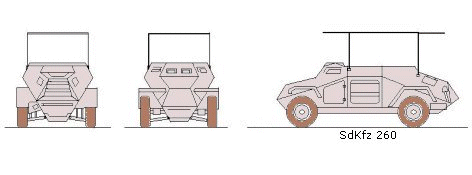
The SdKfz 260, it was based on the 4 Wheel Armoured Car chassis and was in use from 1940 to 1945. |
|
| General Details (Armoured Car) |
|---|
| | Specifications | | Operational Date(s) | 1940 - 1945 | | Ordnance classification | SdKfz 260 | | Quantity Produced | 250 | | Weight | unknown | | Crew | 4 | | M.G's small | n/a | | M.G's large(>10mm) | n/a | | Length | 4.71 mtr | | Width | 1.95 mtr | | Height | 1.70 mtr | | Engine Details/Performance | | Max Road Speed | 53 mph | | Max Cross Country Speed | 15 mph | | Range Road | 200 miles | | Range Cross Country | unknown | | Fuel Type | Petrol | | Fuel Capacity | unknown | | Horse Power | 75 hp | | Power/Weight | unknown | | | General Information | The SdKfz 260, it was based on the 4 Wheel Armoured Car chassis and was in use from 1940 to 1945.
Its main armament consisted
Developed as a replacement armoured car for the Kfz 13/14 in 1934, the vehicle was rolled out into the German army in 1935. The vehicle was based on a standard heavy car chassis with angled armour plates to protect the crew.
The 260 model was unarmed but equipped with a medium range radio which used whip aerials. | |
| | Turret | | Front | n/a | | Side | n/a | | Rear | n/a | | Top | n/a |
| | Superstructure | | Front | | 8mm | @ | 35° | (10mm) | | Side | | 8mm | @ | 35° | (10mm) | | Rear | | 8mm | @ | 30° | (9mm) | | Top | | 5mm | @ | 90° | (5mm) |
| | Hull | | Front | | 8mm | @ | 35° | (10mm) | | Side | | 8mm | @ | 35° | (10mm) | | Rear | | 8mm | @ | 30° | (9mm) | | Top | | 5mm | @ | 90° | (5mm) |
| | Armour (x)mm @ (y)° (Effective mm @ 0°) | | Effective Armour - Maximum 10 mm - Minimum 5 mm |
| |
About Penetration Figures
All penetration figures in this database are calculated to a common standard
based on German WWII testing criteria (complete penetration with functioning fuze).
This allows direct comparison between all nations' guns.
Original national test figures would be higher for some nations due to different criteria:
- German: 1.00? (baseline - strictest)
- British: 1.02? (slightly looser)
- American: 1.05? (50% mass through plate)
- Soviet: 1.10? (75% mass through plate)
For example, a Soviet gun showing 159mm here would be published as ~175mm in Soviet documents,
and a German gun showing 120mm would be published as 120mm in German documents.
The 159mm figure is directly comparable to the German 120mm - the Soviet gun really was more powerful.
|
| National Testing Standards |
|---|
| German: | 1.00? - Complete penetration, fuze functions (strictest) |
| British: | 1.02? - Complete penetration |
| American: | 1.05? - 50% of shell mass through plate |
| Soviet: | 1.10? - 75% of shell mass through plate |
|
All database figures are normalized to German standard for direct comparison.
Multiply by the factor above to see original national test figures.
|
|
|
Hit probability is based on a static 2 x 2.4 metre panel at 0 degrees(vertical) at the range specified.
The data that has been used to create these records has come from Wikipedia, The Lone Sentry, The Bundes Archive
and numerous books and websites that have provided the detailed information that has not been available anywhere else. The
information we use to calculate the penetration tables, flight times and the hit probability comes from the Gun Calibre,
the Shell Mass(Kg) and the muzzle velocity, plus range reductions to allow for gravity and wind resistance. This calculation
originally came from a pre-war Krupp calculation which has been modified, and seems to fit the actual test results.
 
© WWIITanks 1980-2026
If you have any information, or comments on our site,
please E-Mail Simon at
wwiitanks@villagenet.co.uk
Page Last Updated: 2026-03-03
|
|